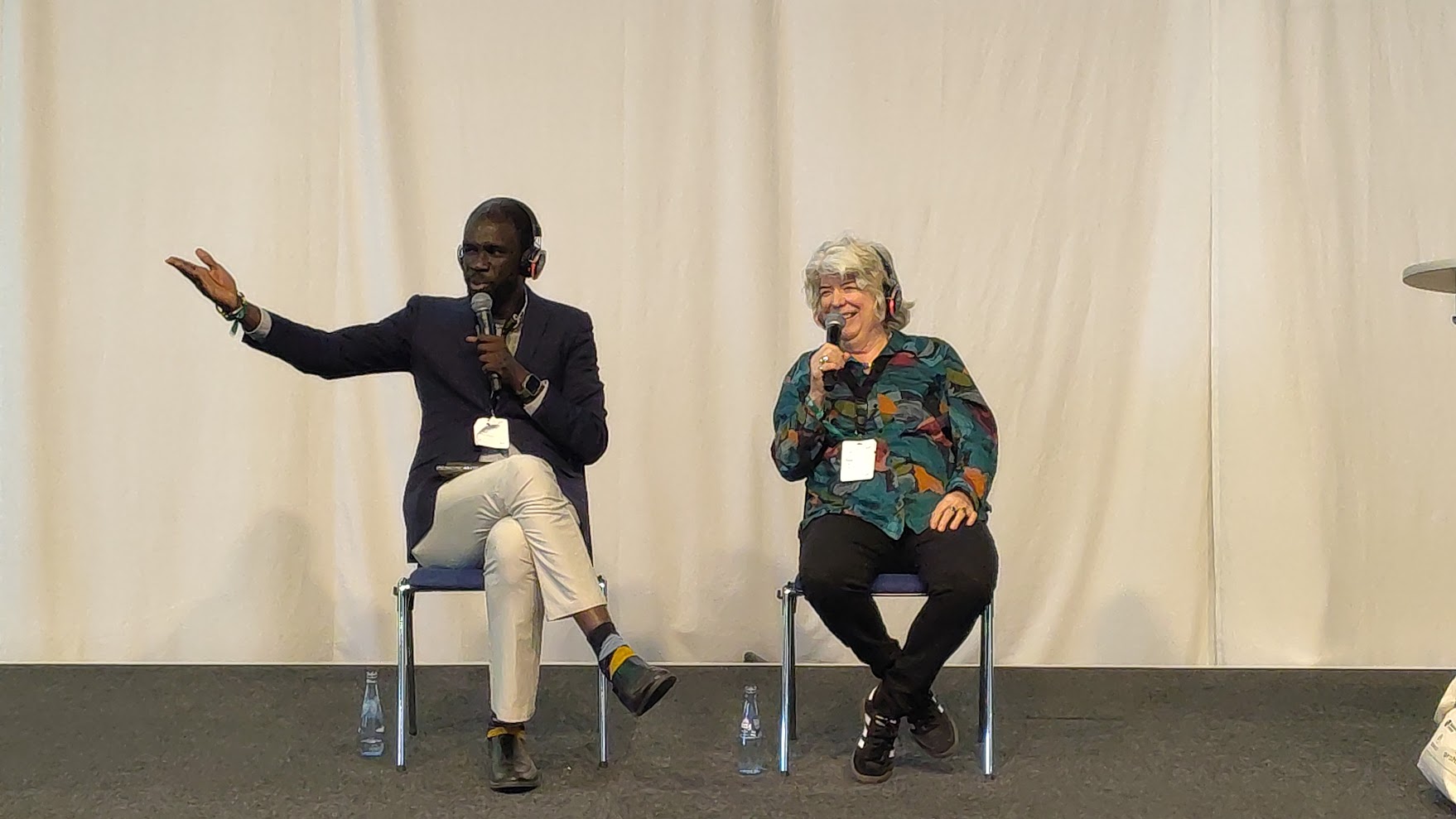
Pape Armand Boye and Lucy Durán, Jazzahead Bremen 2025.
The yearly industry event Jazzahead Bremen always gives me ambiguous feelings beforehand. About 3000 jazz professionals from all over the world connect to do business, but for a genre like jazz it is quite hallucinating to see that the average Jazzahead delegate is male, white and, well, old. I guess this has much to do with the fact that jazz in Europe after world war II became something of an elite thing, its upward social mobility move is fascinating to observe. It also has big advantages since most EU countries actually have built up financial structures to support jazz as art form (whereas most NYC jazzcats play under abysmal conditions: in order to earn a living most of them travel Europe during festival season).
Things are changing fortunately. One could object that this fair does not acurately respond to these very testing times for international cultural collaborations. There is always room for improvement on this matter, especially considering the history of jazz which used to be all about social change.
But if you look at it on the bright side: this time, I had many pleasant conversations with internationals which weren’t only about fees, options and bookings. One major agent from the U.S. just wrote a handbook for musicians and is busy with capacity building in Africa, in order to get more African (jazz) musicians a seat at the tables in Europe. A necesary move.
The eminent School of Oriental and African Studies Professor Emerita and music producer Lucy Durán held a talk on a topic which has my full attention ever since I had the privilige of a private conversation with South African pianist and scholar Nduduzo Makhathini: the notion of African jazz and the need for a new paradigm on that matter. For too long African jazz has been looked at as a somewhat final chapter of the U.S. original. Makhathini is very opinionated about this.
Meanwhile, Durán’s output is just amazing. I did not know that once she studied classical guitar at the conservatory, but after hearing the magnificent kora tradition from West-Africa she changed course and started recording many a legendary album, among others Toumani Diabate for Joe Boyd’s label Hannibal. Why? ‘Because no one else did at the time.’ Love that.
Durán, accompanied by Pape Armand Boy, who runs the Boutique recording studio in Dakar, Senegal, made a joyful, sometimes moving and in any case very convincing plea for seeing things differently and acknowledge the fundamental jazz character in much of Africa’s musical forms, with large amounts of groove and improvisation being key elements.
More good news: much of her earlier brilliant productions with Toumani will again be published, this time via the UK label Chrysalis.
Trio Da Kali and Guitari Baro one should definately check out.
 Tchongcast
Plaats een reactie