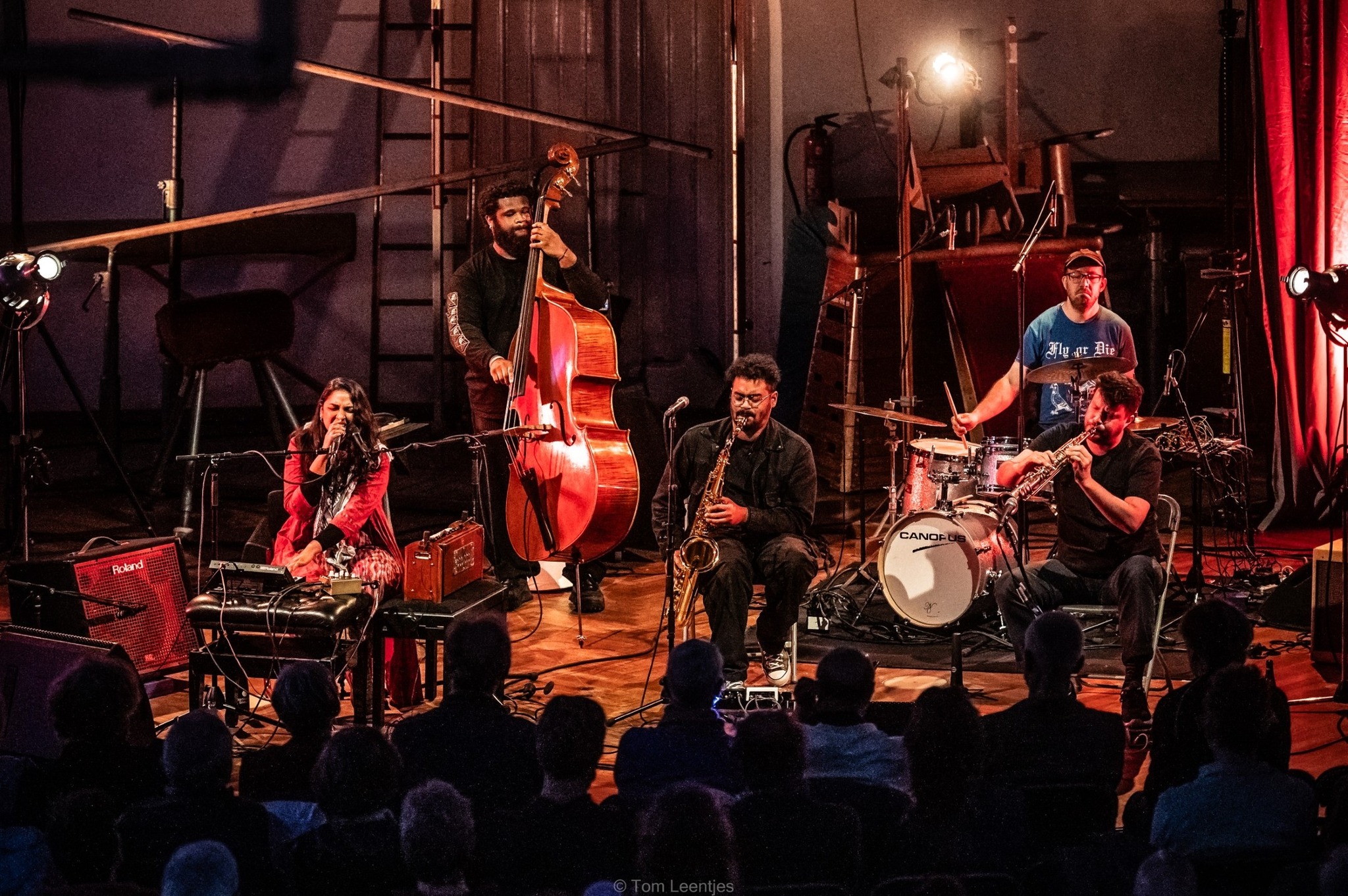
Why did you choose Elder Ones as name? What are the origins of this project?
The project started in 2015, around the police killings of Eric Garner by the NYPD and Mike Brown in Ferguson, the same year I organized a benefit for another victim under the banner “Musicians Against Police Brutality”, which [Chicago based jazz saxophonist] Matana Roberts started. We actually first played a free improv set at a fundraiser benefit Matana organized for Mike Brown in NYC. This was the same year jaimie branch started Fly or Die, so there was an energy in the scene around music that had a socially transformative message.
The name comes from a few things. It primarily refers to the idea that we carry our ancestors with us and that our elders have made the path that we walk on. My ancestors endured colonialism, and now I live in the west making anti-colonial music. My musical elders such as Alice Coltrane or the AACM [Association for the Advancement of Creative Musicians – ed.] make it possible to do what I do now. There was a Lovecraftian allusion in it, as I was reading some of his stories at the time, but after learning he was a virulent racist I’m not really into the reference.
Holy Science, 2016; From Untruth, 2019, New Monuments, 2024. Can you describe the journey on your 3 releases?
It has been a long journey, almost a decade! There is definitely a thread that runs through all three of them, but there has been a development and change throughout. The first album was wordless, so the big change from then to the next one was that I was using text to be able to speak more overtly and directly to the social issues that the music was trying to respond to. We also started to move into using electronics, because the drummer in that line-up Max Jaffe was working with a lot of sensory percussion, Matt Nelson was really exploring noise with pedals and sax in his band Grid and in solo work, and it all inspired me to add a synthesizer and begin to explore with that.
New Monuments is definitely the most epic of the three. The compositions are dense and large in scope and probably the most ambitious I’ve ever attempted. I definitely feel there has been development in my language as a composer, while maintaining the free spirit and openness for my bandmates contribution. The latest line-up includes Lester St. Louis and Jason Nazary who were regular collaborators of jaimie branch’s, so I feel like her spirit is really in this band somehow. We’ve also added Alfredo Colon on tenor, who is such an amazing musician so now there is this different feel with a “horn section” and him and Matt Nelson play off of each other in such an insane way. There’s also way more electronics with Jason’s modular synth, both saxes effects and my vocal effects, so that’s been a big shift.
But the throughline is the social justice message and the latest album continues in this way, dedicated to the “people’s movements”, mass mobilization for social change, from racial justice to climate and labor justice, women’s movements from the West to Iran, anti-colonial and anti-imperial movements from Haiti to Palestine and the youth and student movements for divestment from fossil fuels and the military-industrial complex.
Bhajan singing and karnatic music theory – how did these affect your personal music?
Bhajan singing has the most direct impact, because I actually sang and practiced it my whole life. It is a communal devotional singing practice, which is more like folk music, versus the classical form of Karnatic music. I did practice Bharatanatyam dance, which is deeply intertwined with Karnatic music, so I would say the rhythmic training had the biggest impact on my improvising and composition. Also, the approach to improvisation from Indian music and the modality in Bhajan and Karnatic had a deep impact. I never approach anything from a “music theory” standpoint, more intuitively, so dance has had an impact on that more embodied approach.
You’ve mentioned that you were classically trained, also in Nono/Stockhausen territory, but you moved to free jazz. Can you describe that move?
I was always listening to jazz and singing in jazz bands in middle school and high school, but my training in college and graduate school was in classical music by default. There was no jazz major in both my schools. The move was fairly organic, very much inspired by my musicology research on the AACM and others. Cecil Taylor was probably the most influential and I found his approach to be life changing. He was using his classical training to be fully creative, but also incorporating the approach of Indigenous music and African music. It was totally creative and a universal approach.
I really just wanted more creative freedom to express my true voice, which I really found through improvisation. I also liked the social aspect of it, connecting with different people through improvising freely. You could immediately establish a playing relationship without any background. It is also non-hierarchical and everyone is equal. I appreciated the social and musical aspects and they felt totally intertwined. I also felt it was a more diverse community in NYC and I could bring together all my influences from rock to Indian music naturally.
Hatecrimes against Asian-Americans during and after the corona lockdowns is a strong theme on New Monuments, can you tell us more about how that became a theme for you?
Anti-Asian racism is often overlooked in the United States, though it has been an issue since the late 19th century from the Chinese workers brought for the transcontinental railroad and the Gold Rush in California, the Chinese Exclusion Act, Singh vs the United States (where South Asians lost the right to American citizenship), Japanese internment after Pearl Harbor, Yellow Peril (during the Red Scare around Communism), the Vietnam War, Korean War and on and on. There were even lynchings of Asians in the early 20th century in California. More attention has been paid to racism against Black Americans, for good reason, but I think it’s important to highlight this issue as well and create solidarity in this struggle. There is a history of organizing between Black and Asian people since the 1960s, and you can see examples such as Malcolm X and Yuri Kochiyama working together.
My framework for understanding anti-Asian discrimination, as a South Asian person myself is very influenced by Edward Said, a Palestinian American scholar who wrote the text Orientalism. The concept is that the Western gaze of the Orient and its people is through Western dominance and imperialism. It is that the West is superior and the “Orient” is barbaric, oversexualized, submissive and many other tropes. This is a way of dehumanizing the enemy such as Asians during Vietnam, but also Arabs and Muslims during the Iraq and Afghanistan war and now with Palestinians. It makes it easy to see people as the enemy if you dehumanize them, especially if you kill them. I felt this shift after 9/11 as a brown Indian person. We saw a sharp rise of Anti-Asian hate crimes with Trump calling Covid the “China virus”. We see it again now with hate crimes against Palestinians and Arabs and the rise of Islamophobia alongside antisemitism.
Quite depressing, but since apparently Trump holds a strong chance to be reelected, how is the artistic scene in NYC under that dooming cloud? How do you keep up the spirit?
I hate to tell you, but he will be re-elected unless something changes very dramatically. To be honest though, we are very unhappy with Biden. I know many musicians right now including myself who are very focused on stopping the genocide that our government is allowing to happen, and is totally complicit in. We see the repression of free speech, the arrest of hundreds of students and how intricately connected what is happening in Gaza is to our own democratic values. I don’t know what is going to happen, but we are fighting hard in the streets. The status quo of the two-party oligarchic system we have seems no longer possible. We live in a hyper capitalist, neoliberal oligarchy, not a democracy at all. This has really been exposed. Trump is HORRIBLE, but he is a symptom of a larger problem, not the problem itself.
In your wonderful performance in Bremen I felt that free jazz is as engaged and powerful as ever in your hands, just because of these testing times. Would you say that any sincere music should reflect the time we are living in?
For me, it is an artist’s duty to reflect the time (Nina Simone said this). I really feel that way. I also had many colleagues who inspired me to do this, such as jaimie branch, Matana Roberts, Darius Jones and many others. I think there is no music that exists that doesn’t reflect the times in some way, but I really appreciate music that is challenging the status quo and critiquing the society that we live in. It’s not an intellectual exercise for me. It’s a spiritual and social practice, so it is concerned with humanity.
Amirtha Kidambi’s Elder Ones played in the historical gym room in Bruges, powered by KAAP, friday May 24th 2024. Nicolas Mortelmans Quartet presented their W.E.R.F. Records debut before Kidambi.
 Tchongcast
Plaats een reactie